Corporate Info Products and Support Contact Us Home

  Telescope Laser Collimator
   Innovations in simple and precision form for maximum accuracy


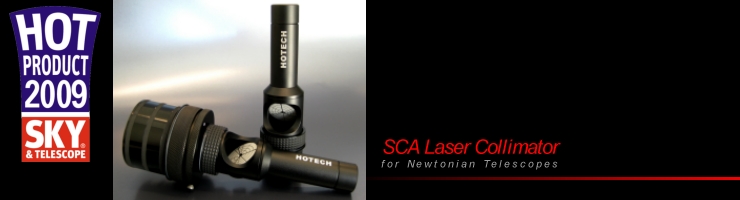
   HOTECH SCA Laser Collimator   Patented
         

Self-Centering Adapter (SCA)

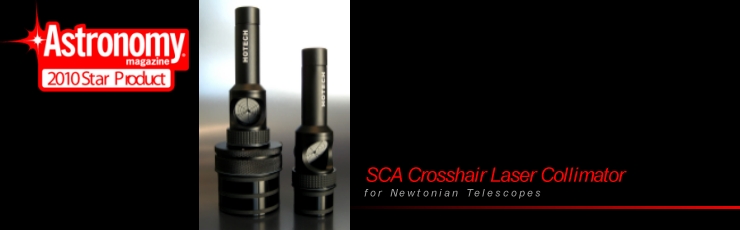
The HoTech laser collimator separates itself from all other laser collimators with its innovative self-centering adapter technology (SCA).  This mechanism allows precise and repeatable installation in all brands of 1.25" and 2" telescope focusers.  All laser collimators in the current market have one fundamental problem, slop in the adapting mechanism between the laser collimator and the telescope focuser.  This problem is clearly recognized and often discussed among astronomers but so far there has been no definite solution in the market.

No matter how tightly the tolerances machined on the laser collimator or the focuser, a small gap is required to allow installation of the laser collimator.  Once the laser collimator is inserted, the required gap becomes a problem.  A laser collimator is secured with one or more thumbscrews or unified compression ring.  Both methods introduce a very critical issue, namely an off-axis installment that instantly destroys the precision of your collimation instrument along the entire optical axis.

Our Self-Centering Adapter cleverly eliminates the slop by linearly compressing the built-in rubber rings.  By doing this, the diameter of the rings expands to compensate the gap.  Because all rings evenly expand radially in diameter from the compression, this automatically centers the laser collimator in the focuser draw tube.  The SCA adapter accommodates various brands of adapting focusers which have slightly different manufacturing inside diameters so our laser collimator will be precisely centered for each installment.


In summary, our SCA adapter serves three critical functions.
First, its expansion rings accommodate almost all focuser's manufacturing tolerances.  Second, it automatically centers the adapting laser.  Third, it provides at least two evenly distributed circular contacts on the focuser's inner tube surface preventing the adapting laser from pivoting.  Once the slop factor is taken away, you can quickly collimate your telescope in confidence to achieve perfect collimation every time.


The Problem


1. The Thumbscrew Gap:

The thumbscrew pushes the laser collimator off to one side of the adapting eyepiece focuser.  This off-axis distance creates a gap between the collimator's outside diameter and the focuser’s inside diameter.  No matter how accurately the laser is internally aligned, the displacement gap offsets the laser when fastened with the thumbscrew.  The displacement may seem small, but the misalignment grows when the laser beam travels a relatively short distance.   With slightly off, miscollimated mirrors in a fast telescope (F/5 or faster), the problem compounds substantially.  The illustrations below show how the laser beam is offset in three scenarios when the laser travels from the collimator to the primary mirror (in red line) and returns back to the laser origin (in blue line).

In figure 1, the primary and the secondary mirrors are collimated but the laser is installed offset, by the thumbscrew, from the true optical axis.  The laser only travels roughly parallel along the optical axis, but not on the axis, and returns with the same initial offset distance (assuming the focuser tube is parallel to the optical axis).  In this case, the user will be tricked into adjusting the secondary mirror first to center the laser dot on the primary, then adjusting the primary to point the laser back to the center of the true optical axis.  The attempt ruins a perfectly collimated telescope by adding astigmatism from the tilt compensation.


                                                    collimated                          misaligned

In figure 2, the primary is off 1 degree and the secondary is square to the focuser, and again the laser is installed offset from the true optical axis cause by the thumbscrew.  The deviation of the returning laser dot from the primary increases compared with the figure 1 scenario.


In figure 3, the primary is collimated, the secondary is off 1 degree to the true optical path, and the laser is installed offset from the true optical axis caused by the thumbscrew.  The deviation of the returning laser dot from the primary increases even more.


2. Adapting with Unified Compression Ring:

The unified compression ring actually does not do what it states.  The mechanism simply uses a thumbscrew crushing (but not uniformly contracting) an internal brass ring to clamp on the inserted tube.  When you take a closer look, it only forces the brass ring to bend into an off-centered oval ring creating two clamping points (not 360 degrees surface contact as you thought would be) on the inserted eyepiece tube (see photos below).


This spells disaster for a laser collimator.  With two sides clamping down creating two linear contacts, the compressed ring actually opens the other two sides wider even with a relief cut in the ring.  In addition, by design, the brass ring has to be larger than the adapting tube, so the total widened gap is even wider than the simple thumbscrew method.  The two-point clamping allows the inserted tube to wiggle/pivot on the wide/tangent sides. The only thing preventing it from pivoting is making sure the shoulder of the laser collimator is flush against the rim of the focuser and is tightly locked down with the compression ring.  But when you wiggle the laser collimator just a little more, you will find it starts to loosen up which allows the laser to dance around on the projecting mirrors in the orthogonal directions of the clamping points.  This “dancing laser spot” problem gets real frustrating because the user cannot repeat the laser collimation consistently.


Problem Solved with SCA Adapter Technology 


Many laser collimator manufacturers give users the wrong impression, “big and heavy means rugged and stable.”  Instead, HoTech engineers successfully cut the unnecessary weight on the laser collimator because we understand that additional weight on a telescope (especially open structure Newtonians) will create imbalance and structure sagging.  In addition, the heavier the device is, the more inertia it will have during an impact from an accidental drop.  In such an accident, the inertia force can cause more damage to the internal alignment mechanism because there is more energy required to dissipate from the impact.  Therefore, the lightweight design on our laser collimator makes you gain reliable precision collimation.  And of course our laser collimator uses aero-space grade lightweight aluminum material and CNC machined with the tightest tolerances, then sand blasted and anodized to protect from harsh environment.  Nothing has been sacrificed while you get a long lasting state-of-the-art collimation instrument.


More Technical FAQ on laser collimation

Includes 45º Faceplate Viewer with Laser Engraved Targeting Grid


The faceplate viewer helps to display the returning laser spot with a clear visual reference during adjustment.  The faceplate allows you to align your primary mirror from the rear of the telescope eliminating traveling to the front of your scope repeatedly during collimation. 


HoTech understands the importance of this, so the faceplate is a standard feature in our laser collimator.  All astronomers deserve to have it without paying any extra!

In addition, our faceplate viewer’s pattern is laser engraved to ensure a long lasting sharp targeting grid.  Unlike other collimators, the target is not a sticker that will peel, or paint that can rub off or chip.  We understand that you are paying for a precision instrument that is supposed to be well made.


Finest Projecting Laser Dot

   Keeping the laser dot to the finest point is the key to precision collimation.  But when you look closely at the laser dot from brand to brand, most laser dots appear large, not really a fine point as you imagined.  This means there is guess work involved when you try to center the dot; not just centering the laser dot to the center of the faceplate, but also centering the center of the dot itself.  This does not make any sense when you are trying to take the advantage of the collimated laser beam's characteristic "which has a low beam divergence, so that the beam radius does not undergo significant changes within moderate propagation distances."  In other words, the laser beam size within the collimation distance (laser collimator to
the primary mirror and back to the faceplate) should remain a constant fine point.  As you know, most laser collimator brands are not really laser manufacturers.  They install an off-the-shelf laser module or pointer and align the laser in a tube without REALLY considering the user’s application, namely the operating distance for a laser beam size.  HoTech has been designing and building laser modules and systems for over 10 years for various professional industries.  We know exactly how a laser should work.  We limit our laser beam to the finest size in the correct operating distance for optimal effect.  Our understanding and experiences with the laser design permit you to have an effective and precision collimation.


High Accuracy Laser Alignment

Our laser collimator is well centered and aligned which are critical factors for an accurate collimation.  But you will be surprised that many laser collimators in the market fail in this regard.  The reason is in the design and understanding of the product itself.


We considered all aspect of parameters in our design.  Parameters like the alignment mechanism, mechanical and optical structure of the laser itself, and more are taken as part of our design.  For instance, some laser collimators actually install an off-the-shelf laser pointer in the casing.  It is very cost effective (for seller), but it inherits numerous problems.  In many cases, the laser pointer might not install perfectly centered in the casing due to pointer size variations and the added alignment mechanism.  So the laser itself is not positioned on the true alignment point and optical axis.  As the result, the laser can never be center-aligned in the enclosure.  It is possible to align the laser beam parallel to the optical path but always with an offset along the optical axis.  This means the laser beam is off no matter how you center adapt the laser collimator to the focuser.  The result of off-centered laser will introduce astigmatism into your telescope which is similar to figure 1's scenario.


Long Lasting Battery Life
By using the CR123, 3V battery as our laser power source, our laser collimator has over 65 hours of continuous use battery life time.  The included CR123, 3V lithium battery operates well under a typical cold night and it has a 10 years shelf life.  This is a great advantage that you don't have to worry about changing the tiny hard to find cell batteries frequently in the dark like other collimators.

Collimation for your SCT
Commercially made SCTs all have slight optical and mechanical alignment errors.  The error typically is in the centering of the secondary mirror.  As the result, when a laser is installed and emitted from the focuser, the beam will seldom return dead center, even though star testing would indicate perfect collimation.  In addition, the secondary mirror, convex shape, magnifies any error by about 5 times.  The error of deviation for a typical well collimated SCT will return laser beam at around 0.125" to 0.250" off center.  In order to compensate the optical and mechanical alignment errors of SCT, a different collimation approach is required in compare with Newtonain telescope.  If the procedure is followed through correctly, users can still accurately collimate their SCT.

By default, the laser will have to be position in the optical center of the SCT.  HoTech SCA laser collimator automatically eliminates the focuser slop without using the thumbscrew and center position itself on optical axis.  For SCT, the primary mirror is fixed, but you can collimate by adjusting the secondary mirror to point parallel to the optical axis.

There is an one-time-only preperation you need to do for SCT laser collimation.  First, install the SCA laser collimator and premark the laser position on the target grid of the collimator when your telescope is collimated from the factory or from your star collimation. Then when you check for collimation next time, just adapt the SCA laser collimator on the focuser, 2" or 1.25" and see if the laser falls on the premarked laser position.  If not, adjust the alignment screws on the secondary mirror to move the returning laser dot to the premarked postion on the target grid.  See illustrations below.


Diffraction Grating Pattern Lens on our SCA Laser Collimator

Since our SCA Laser Collimator is already accurate with the SCA technology, fine laser dot, and the built-in 45 degrees faceplate, there is no need to use the DFG pattern to align the primary mirror of a Newtonian telescope.  The purpose of using DFG pattern is to gross alignment the primary mirror.  The user aligns the primary mirror by referencing the shadow of the secondary in the projected DFG pattern on a wall, and user counts the DFG dots around the shadow to center in the shadow.  This method cannot achieve accurate alignment because the gap between each dot can make a big alignment difference.  At the final alignment stage, the user must bring the laser dot back to the laser exit (the center of the 45 degrees faceplate).  Our built-in 45 degrees faceplate allows you to align your primary mirror from the rear of the telescope eliminating traveling to the front of your scope repeatedly during collimation like other collimators.  Therefore, there is no need to use DFG lens in conjunction with our SCA Laser Collimator.

Available Models
1.25" Laser Collimator: Single complete laser collimator with built-in SCA adapter.
    2" Laser Collimator: The unit works for both 2" and 1.25" telescopes.  It comes with a 1.25" SCA laser collimator pre-loaded in a 2" to 1.25" SCA adapter.

The SCA Laser Collimators work with all Newtonian and SCT telescopes using standard 2" or 1.25" focusers.


Check out and download the SCA Laser Collimator User's Manual.
     - SCA Laser Collimator for Newtonian (PDF format).
     - SCA Laser Collimator for SCT (PDF format).
     - SCA Laser Collimator for Star Collimation
 (PDF format).
     - SCA Laser Collimator Specification (PDF format).

Related Article Links

The Collimation:
    - by Tierry Legault, a detailed paper about telescope collimation.
FAQ about Collimating a Newtonian telescope:
    - by Nils Olof Carlin, excellent article covering collimation facts with clear illustrations.
Collimation with a Barlowed Laser:
   - by Nils Olof Carlin, Clear step-by-step instruction and an explanation of laser collimation.
Cloudy Night Telescope Reviews:
   - by Eric Planalp, Review on 1.25" laser collimator with pros & cons.
Definition of Collimator:
   - Definition of the term collimator from Wikipedia.org, yourdictionary.com, and answers.com.

To Order   McAfee Secure sites help keep you safe from identity theft, credit card fraud, spyware, spam, viruses and online scams

- 1.25" SCA Laser Collimator $89.95 + S/H.
- 2" SCA Laser Collimator $120 + S/H.
- Secure 24 hour ordering online within the U.S.A.
- International orders: We ship to worldwide destinations. Please contact us by email, fax, or phone for your order.
- By email: sales@hotechusa.com.
- By phone: (909)987-8828 option 4, Monday - Friday: 9AM to 6PM PST.
- By fax: (909)987-8809 24 hours.
Shipping and Handling Charges
-   Domestic orders: You can choose UPS Ground (except Hawaii and Alaska), UPS 3 day (except Hawaii and Alaska), UPS 2nd day, or UPS Next day. Orders in Hawaii and Alaska shipped via Postal Priority Mail.
- Orders in Canada: shipped via UPS Standard or Postal Priority Mail at approximately US$15.
- International orders: shipped via Postal Express Mail at US$25~30 depending on the destination.

Laser Safety Precaution
Please see Laser Safety and Warranty for detail.

Product Warranty
Please see Laser Safety and Warranty for detail.

 Go to top of this page

With Special thanks to Rudy Rodriguez, Martin Carey, and Jack Borde for their support in providing helpful knowledge from their experiences in the astronomy and optical field, and to all friendly astronomers who have supported us with their views and comments.

Copyright © HOTECH Corporation. All Rights Reserved.
All trademarks and brands are property of their respective owners.
Use of this web site constitutes acceptance of the Terms of Use and Privacy Policy.